Message from the CEO: ABA Member Updates | October 2026
Thursday, October 15, 2026
Posted by
Ed Dellert, RN, MBA, CAE, FACEHP, Chief Executive Officer
As we move through the final months of 2026, I remain inspired by the dedication, innovation, and collaboration across the burn-care community. From advances in research and education to disaster readiness, advocacy, and international partnerships, the American Burn Association (ABA) is moving forward with purpose.
You hear from me often about ABA’s Strategic Plan and how it provides the framework for this work, but its importance lies in the commitment of our members, volunteers, Board of Trustees, industry partners, and ABA staff, who bring it to life. We are increasingly moving from planning to action—strengthening programs, building partnerships, and finding new ways to support our members and advance burn care.
As we prepare to celebrate ABA's 60th anniversary in Chicago next year, we have much to celebrate and even more to look forward to.
Measuring Our Momentum
Our progress is reflected not only in the initiatives underway, but also in the burn-care community's growing engagement and support.
This year's ABA Annual Meeting welcomed 2,333 attendees, compared with 2,279 in 2025. Scientific abstract submissions closed a few days ago, up 16%. This growth reflects our community's continued enthusiasm for research, discovery, and sharing new knowledge.
These indicators are encouraging and reflect our community’s strength and the value of our programs. More importantly, they represent opportunities to reinvest in education, research, quality improvement, prevention, and services that benefit our members.
Growth is important, but what matters most is how we translate that growth into greater impact.
Connecting and Collaborating Across the Burn Community
The past several weeks have reinforced the importance of learning from one another and building relationships beyond our own institutions.
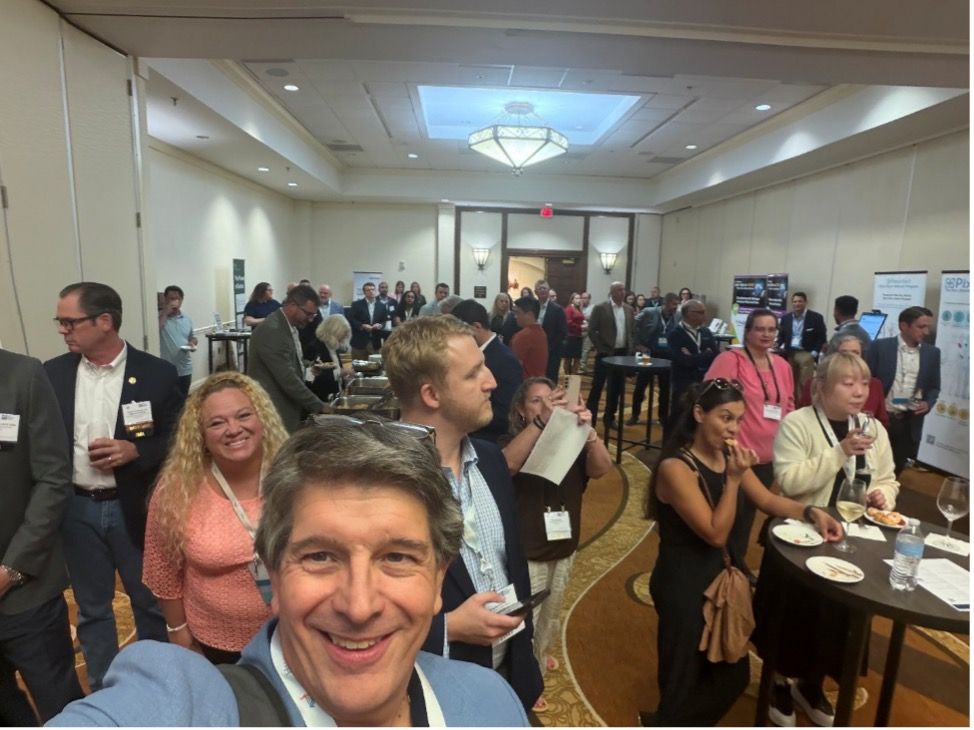
From the Southern Region Burn Conference and Canadian Burn Association meeting to the International Society for Burn Injuries (ISBI) Congress in Santiago, Chile, these gatherings provide opportunities to exchange ideas, strengthen professional connections, and advance our shared commitment to burn care. I also look forward to the Midwest Region Burn Conference in October.
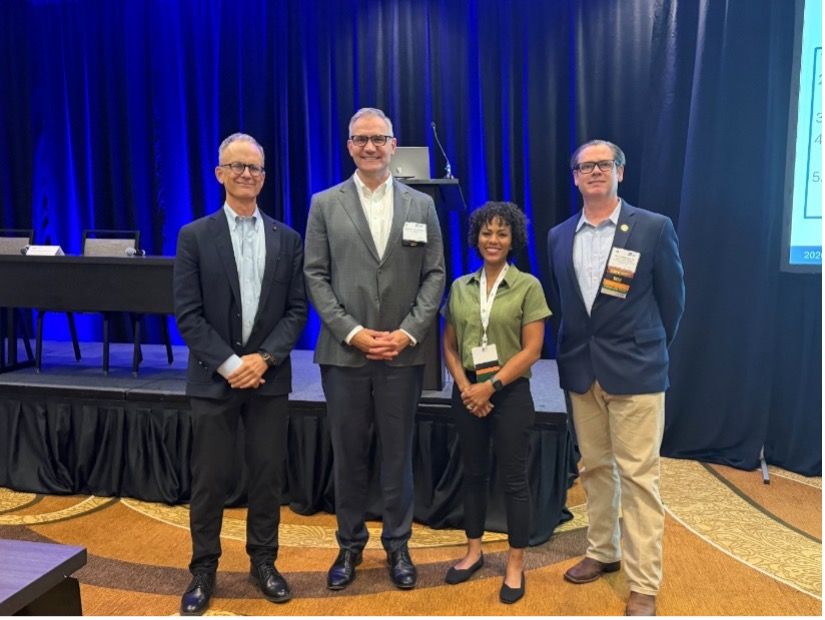
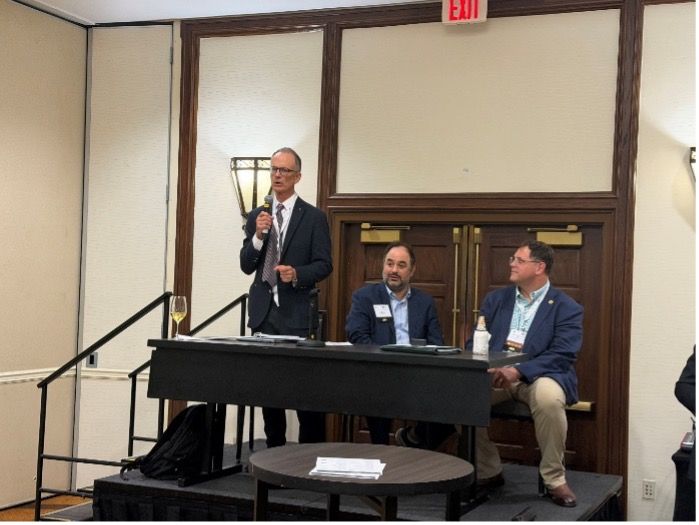
Our recent Burn Surgeon Forum in San Antonio was another successful gathering, bringing together burn surgeons, thought leaders, and industry partners for meaningful discussions about innovation, leadership, research, workforce challenges, and the evolving needs of burn centers.
I extend my sincere appreciation to our Course Directors, Drs. Alicia Williams, Duncan Nickerson, and Arek Wiktor, for their outstanding leadership, along with our faculty, moderators, participants, and industry partners.
An important priority for ABA is strengthening how our committees, Board of Trustees, and staff work together year-round to advance our mission and the current Strategic Plan.
On October 9, we launched our inaugural Committee Leadership Quarterly Update, bringing together committee chairs, co-chairs, and deputy chairs for a new forum focused on communication, collaboration, and shared organizational priorities.
This initiative is about more than providing updates. It is about building stronger connections across ABA, ensuring committee leaders understand the association's broader work, and identifying opportunities for committees to collaborate rather than operate independently.
Our inaugural meeting highlighted the work of the Disaster, Organization and Delivery of Burn Care, and Pediatrics Committees, demonstrating the breadth of initiatives underway, from national disaster readiness and workforce resources to burn center and fellowship directories, pediatric care, and research.
Just as importantly, these discussions identified opportunities for committees to collaborate, share expertise, address common challenges, and seek support from ABA leadership and staff to advance key initiatives.
While each committee has its own responsibilities, many of the opportunities facing our profession cross traditional committee and disciplinary boundaries. Our goal is not simply to have strong individual committees, but to build a more connected and collaborative volunteer leadership community that collectively advances ABA's work throughout the year.
This is also an opportunity to strengthen the relationship between our committees and the Board of Trustees by increasing visibility into committee priorities, emerging needs, and progress toward our strategic goals. We recognize that this new approach will evolve as we learn together, and we welcome that opportunity.
I am grateful to our committee leaders and members for the tremendous time, expertise, and commitment they contribute to ABA.
Our call for Board of Trustees nominations has recently concluded, and we will soon invite members to express interest in committee service and other volunteer leadership opportunities.
ABA's greatest strength is our members' expertise and engagement. By connecting that expertise across committees, disciplines, and leadership, we can accomplish far more together than we can individually.
Volunteer leadership is more than filling a position. It is an opportunity to contribute your expertise, learn from colleagues, develop as a leader, and help shape the future of ABA.
Advancing Disaster Readiness: Preparing for What Comes Next
A recent Newsweek article by Robert Mardini, CEO of Geneva University Hospital, offered an important perspective on healthcare resilience following the tragic New Year's fire in Crans-Montana, Switzerland. The response required hospitals and burn centers across multiple countries to work together to care for patients with severe burn injuries.
The experience reinforces an important lesson: disaster readiness is not simply about having a plan. It is about having the people, relationships, information, and systems in place to respond when the unexpected occurs.
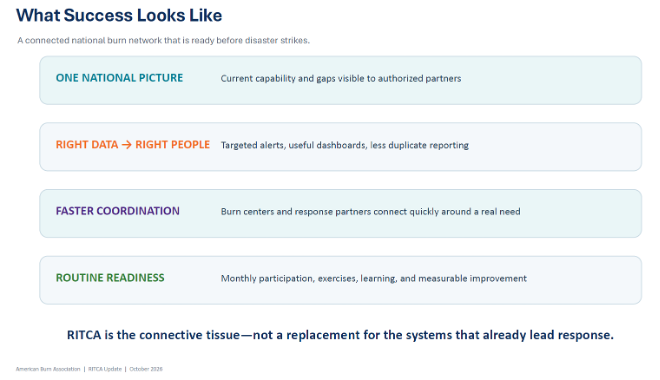
This is central to ABA's ongoing work with the Regional Incident Tracking and Coordination Application (RITCA).
After this summer’s successful disaster readiness testing, ABA continues working with federal and technical partners, burn centers, and regional disaster leaders to improve communication, strengthen access to timely information, and advance a more coordinated national approach to burn disaster preparedness.
Our next phase will focus on optimizing technology and data infrastructure, strengthening burn center participation, and establishing routine testing and exercises that translate preparedness into demonstrated capability.
This work is building toward ABA’s next Disaster Burn and Trauma Summit in Washington, DC, in February 2027. The Summit will bring together federal partners, military organizations, surgical and emergency trauma organizations, firefighter organizations, burn care professionals, and disaster preparedness leaders to assess our progress, share lessons learned, and identify priorities to strengthen our collective readiness.
No single burn center can prepare for every possible disaster alone. Our collective readiness depends on how effectively we connect, collaborate, and learn together. The Summit is another important step toward a more connected, responsive, and resilient national burn care system.
We are also expanding the value of ABA’s data and workforce initiatives. Our Organization and Delivery of Burn Care Committee is working to make workforce reports and related resources more accessible to members, helping inform workforce planning and supporting burn center leadership.
Together, these efforts reflect ABA’s commitment to strengthening not only the care we provide today, but also our collective ability to respond to tomorrow's challenges.
Advocating for Burn Care and Its Future
Another important responsibility of ABA is helping ensure that burn centers and the professionals who care for patients have the resources, recognition, and support necessary to deliver high-quality care.
Our Economics and Access Committee continues to advance work related to procedural coding, reimbursement, and the financial sustainability of specialized burn care.
At the federal level, ABA is strengthening its advocacy efforts through our partnership with The Conafay Group, focusing on burn research funding, disaster readiness, reimbursement policies, workforce development, and access to specialized burn-care services.
Much of this work remains ongoing, but these efforts represent an important investment in ABA's ability to serve as a collective voice for the profession.
Advancing burn care requires not only scientific and clinical excellence, but also the policies, resources, and systems that make excellent care possible.
Looking Ahead to ABA 2027 and Our 60th Anniversary
Preparations are well underway for the 2027 ABA Annual Meeting in Chicago, where we will celebrate an extraordinary milestone: 60 years of the American Burn Association.
Our scientific program continues to benefit from our members' remarkable research, innovation, and expertise. Thank you to everyone who submitted abstracts and case reports, and to the volunteer reviewers and program leaders who help make our Annual Meeting such an important educational and scientific gathering.
Our ABA 2027 Industry Prospectus is now available, offering organizations opportunities to engage with the burn care community through exhibits, sponsorships, and strategic partnerships.
To strengthen industry engagement, I am pleased to welcome Linda Cohen from our SB Expo team, who will work closely with Maureen Kiley and ABA leadership to expand relationships and develop new partnership opportunities leading into the 2027 Annual Meeting and beyond.
Our goal is to move beyond traditional exhibits and sponsorships toward a more collaborative, year-round approach to industry partnerships—one that creates mutual value while supporting innovation, education, research, and the advancement of burn care.
We appreciate our industry partners' continued support and look forward to building even stronger relationships.
Under the leadership of our Archives Committee, preparations are underway to recognize the people, discoveries, milestones, and contributions that have shaped our profession over six decades.
But our anniversary is about more than looking back. It is also an opportunity to consider what the next 60 years of burn care can and should become.
As we prepare to celebrate 60 years of ABA, I encourage members to consider nominating colleagues whose contributions have advanced burn care and strengthened our profession. Use this link to explore upcoming award and scholarship nomination opportunities and help us recognize the individuals making a difference across our community.
Our history is worth celebrating, but we are building our future together.
This program will explore operational, financial, workforce, and policy challenges facing burn centers, offering practical perspectives to help our interprofessional community prepare for what lies ahead.
Along with upcoming On-Demand recordings from Burn Surgeon Forum, the Masterclass Series reflects ABA's commitment to delivering relevant, accessible education throughout the year—not simply during our Annual Meeting.
Reflections from ISBI: Mentorship, Research, and the Power of the Burn Team
One highlight of my participation in the ISBI Congress in Santiago was connecting with colleagues from around the world and recognizing the important contributions ISBI continues to make in advancing burn care globally.
ISBI is a valued strategic partner for ABA. Our shared commitment to education, research, prevention, and collaboration creates important opportunities to strengthen burn care worldwide.
I was particularly inspired by Dr. David Greenhalgh, recipient of the 2026 Tanner-Vandeput-Boswick Burn Prize, whose reflections on his career emphasized mentorship, research, advocacy, lifelong learning, celebrating accomplishments, and the extraordinary importance of the burn team.
His message was a timely reminder that progress in burn care is not the accomplishment of one individual or discipline. It results from the collective expertise, compassion, and dedication of professionals working together.
In that spirit, ABA's Board of Trustees recently approved using the term "interprofessional" consistently across our organizational communications, programs, and initiatives when referring to the burn-care team's collective expertise and contributions. See sidebar note for more details.
This is more than a change in terminology. It reflects an important recognition that excellent burn care depends on the knowledge, skills, and contributions of physicians, nurses, therapists, advanced practice providers, psychologists, social workers, researchers, and many other professionals working together.
The strength of burn care lies not simply in the expertise of individual disciplines, but in how those disciplines come together for the benefit of patients and families.
As ABA approaches its 60th anniversary, Dr. Greenhalgh's reflections offer an important challenge: celebrate our accomplishments, recognize the contributions of the entire burn team, invest in mentorship and the next generation of professionals, strengthen our partnerships, and continue learning from one another.
Your Membership. Our Shared Future.
As we begin our fall membership renewal and new-member outreach efforts, I sincerely appreciate your continued commitment to ABA.
Membership is more than access to education, resources, professional development, or a network of colleagues, though each of those benefits matters.
It is an opportunity to belong to a community that is actively shaping the future of burn care.
When you support ABA through your membership and volunteer leadership, you also support a collective voice for the profession—one that advocates for research funding, appropriate reimbursement, workforce sustainability, disaster readiness, and policies that help ensure patients can access the specialized care they need.
Every research submission, committee contribution, educational presentation, professional connection, and shared ideas helps move our mission forward.
I encourage you to renew your membership, invite a colleague to join, and consider becoming more involved in ABA’s work.
As I reflect on all we have accomplished this year, I am reminded that ABA’s true strength has never been defined simply by the number of programs we offer or the meetings we convene. It is defined by the people who believe in our mission and are willing to work together to make a difference.
Sixty years of progress have brought us to this moment. What we accomplish next will depend on the strength of our partnerships, the courage of our ideas, and our shared commitment to those we serve.
Thank you for your leadership, your contributions, and all that you do for the burn-care community. I am grateful to be part of this remarkable organization and look forward to all we will accomplish together.
Warm regards,
Ed Dellert, RN, MBA, CAE, FACEHP Chief Executive Officer American Burn Association
Sidebar Note
The ABA's Board of Trustees recently approved the consistent use of the term "interprofessional" when referencing the entire burn care team across our communications, membership, programs, and initiatives. This decision reflects the importance of using consistent, inclusive language that recognizes the many professions contributing to burn care.
Why does this matter? Because burn care has always been a team effort. Every profession brings unique expertise, perspectives, and contributions to the care and recovery of patients and their families. By consistently referring to the interprofessional burn team, ABA reinforces the value of every member of that team, the importance of working collaboratively, and our shared commitment to advancing excellence in burn care.
It is a small but meaningful step in ensuring that our language reflects who we are as a burn community and the collective strength that defines our profession.